Silvopastoral systems: Raising cattle with trees
Translated from Portuguese. Original published by PRETATERRA.
For an Ancestral Diet That Is Good for People and the Planet, or Why Agroforestry Brings in Cattle
Cattle Agroforestry in Brazil – an explanation.
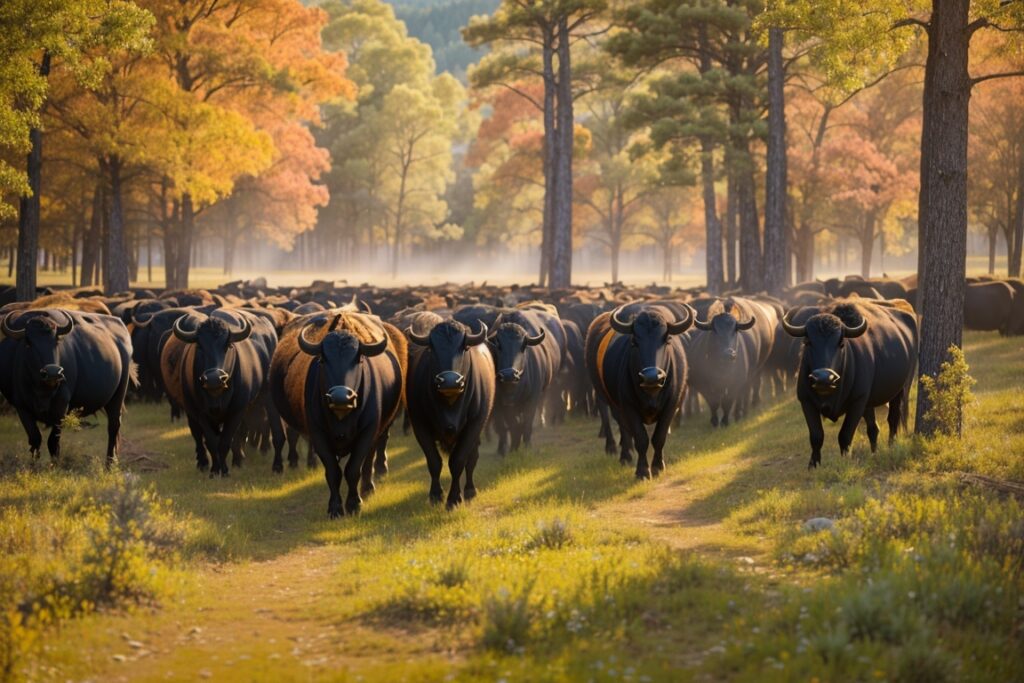
In our relentless pursuit of a more sustainable future, our goal is to move all of the world's cattle into integrated agroforestry systems. There, they will graze on grass instead of being fed grain, enjoying free and contented lives in herds.
While transforming global dietary patterns, beliefs and perceptions is a monumental task, giving our herds more dignified lives is within our reach.
The very act of grazing transforms the environment, cycling water and nutrients. In regions that lack the natural capacity to cycle enough nutrients, cattle play a crucial role in enriching and fertilizing entire ecosystems.
For example, the Savory Institute ranks the planet's zones on a brittleness scale, showing that in certain areas the cycling of "gray matter" (organic matter) can only happen effectively when substantial herds are present. The bovine stomach and gut microbiome act as the soil in a suspended nutrient-cycling system, especially where climate or soil limitations exist.
In essence, smart, regenerative livestock farming can reach carbon neutrality or even become carbon positive. It can deliver more environmental benefits than if there were no cattle at all. Livestock is not the enemy of the environment; on the contrary, it can enhance it.
We should consider not only soil carbon sequestration, the formation of humic carbon in the subsoil from the mineralization of grass root systems, and the nutrient cycling in the soil driven by the herd itself (which would not happen with the same intensity without it), but also the three-dimensionality of agroforestry.
The concept of stratification in agroforestry, or layers of above-ground biomass production, creates "levels" of suspended carbon per hectare (unit of area). Note that certification/accreditation bodies such as VERRA are still far from developing robust methods for complex production systems.
In Brazil, Embrapa has pioneered the integration of agrosilvopastoral systems, commonly referred to as ICLF (Integrated Crop-Livestock-Forestry).
This innovative approach has grown substantially in recent years. The ICLF strategy involves using several production systems at the same time, including crops, livestock and forestry, within the same area. This integration happens through different methods, such as intercropping, succession or rotation, with mutually beneficial results for all of these farming activities.
Beyond the ICLF network (Associação Rede ILPF) in Brazil, developers of complex agroforestry systems, exemplified by organizations such as PRETATERRA (www.pretaterra.com), have gained notable prominence in developing more sophisticated three-dimensional pilot systems. These initiatives were carried out together with major industry players such as Vital Proteins, AGS Agronegócio Sustentável and Luxor Agro's Pasto Vivo project, raising the potential of livestock as a carbon sink to unprecedented levels.
When we turn our attention to nutrition and the circular economy of by-products, it becomes clear that the most significant nutrition lies in organs and bones. Embracing the "nose-to-tail" philosophy reconnects us with our ancestral selves and with using every part of the animal, not just the select "prime" cuts.
In a world struggling to feed its growing population, discarding these parts as waste is morally unacceptable, especially given the coexistence of obesity and malnutrition.
Animal bones and fats are foods of exceptionally high nutrient density. In fact, our leap in intelligence during evolution is believed to be linked to the consumption of bone marrow.
This transformation happened as we learned to use tools and crack open the bones of carcasses, as explained by professor and food archaeologist Dr. Bill Schindler, creator of Modern Stone Age Kitchen, in a remarkable talk titled "Food Archaeology" at the FRU.TO – Dialogues on Food event.
In fact, we should no longer measure food only in kilograms or tons; it is time to focus on assessing "nutrition", or nutrient density. The real question is understanding the nutrient-per-area ratio, which lets us unlock the potential to optimize the Earth's productive area. This concept not only reshapes how we see food, but also helps us envision a more efficient and sustainable use of our planet's resources.
A deep understanding of ecosystem relationships helps us overcome misconceptions. Scarce findings drawn from dubious observations lead to wrong conclusions. When citing meat versus vegetable production data, articles rely only on feedlot data from North America, not on grass-fed cattle in the Americas and around the world.
Moreover, the failure to weigh consumption against the elements of production is deliberately and maliciously left aside, as in the case of water use in beef production, according to the evidence in the book "Sacred Cow".
For grass-fed cattle, this water comes from rain (no irrigation) and does not effectively "consume" or divert water resources, as is commonly believed, since the rain would fall anyway, with or without cattle. Meanwhile, cow manure and urine, which return water and nutrients to the soil, are completely left out, ignoring the nutrient cycling of the herds.
Furthermore, among a series of misconceptions, the most alarming is the belief that saturated fat causes deaths and heart attacks. On the contrary, processed industrial foods, together with processed (grain-derived) vegetable oils, sugar and carbohydrates, are the real culprits. Many doctors have failed to keep up with current research. Misleading studies, driven by an agenda to promote margarine and soybean and corn oils, spread this false narrative.
Our grandparents and great-grandparents did not suffer from diabetes, obesity and depression at the same rate. These modern afflictions result from reduced consumption of animal fats and excessive intake of (highly inflammatory) omega-6 fatty acids, the real instigator of arterial inflammation.
We are aware that pesticides permeate our environment, affecting both animals and plants. However, pastures such as Brachiaria sp. and other grasses receive significantly fewer or no chemicals compared to soybeans, corn and other crops. As a result, the accumulation of pesticides in grass-fed cattle is practically negligible. In contrast, the use of systemic pesticides, including glyphosate, in soybean farming (which permeates almost every aspect of our food supply) is alarmingly high. That is the real problem at hand.
In conclusion, the main threat wreaking havoc on our ecosystems, soil and society at large is the monoculture of grains grown for vegetable oil production, combined with feed derived from the agrochemical package of large-scale industrial agriculture and synthetic food impostors.
Authentic agroforestry operations must prioritize biodiversity and include animals. This approach embodies the ultimate concept of the farm and of resilience, giving us the chance to live in line with our ancestral roots, in a healthy, harmonious way and, above all, free from the shackles of a system imposed on us.
Finally, as a disclaimer, this article does not endorse feedlots, let alone the industrialization of animal production processes or the dehumanization of animal production. Above all, the main goal here, even if it contradicts unscientific agendas and common misconceptions, is to promote a better life, dignity and welfare for all species currently raised as food on this planet. Agendas that fail to consider scientific and empirical data comprehensively, holistically and rigorously in order to truly understand what would genuinely make sense for preserving life on Earth, promoting greater equity among species and peoples, probably harbor questionable intentions that are not sincerely concerned with the climate, human health or animal welfare.
Who among you is ready to embark on this journey of self-sufficiency and responsibility for our planet?
Insights are welcome.