Regenerative agroforestry at scale
Translated from Portuguese. Original published by PRETATERRA.
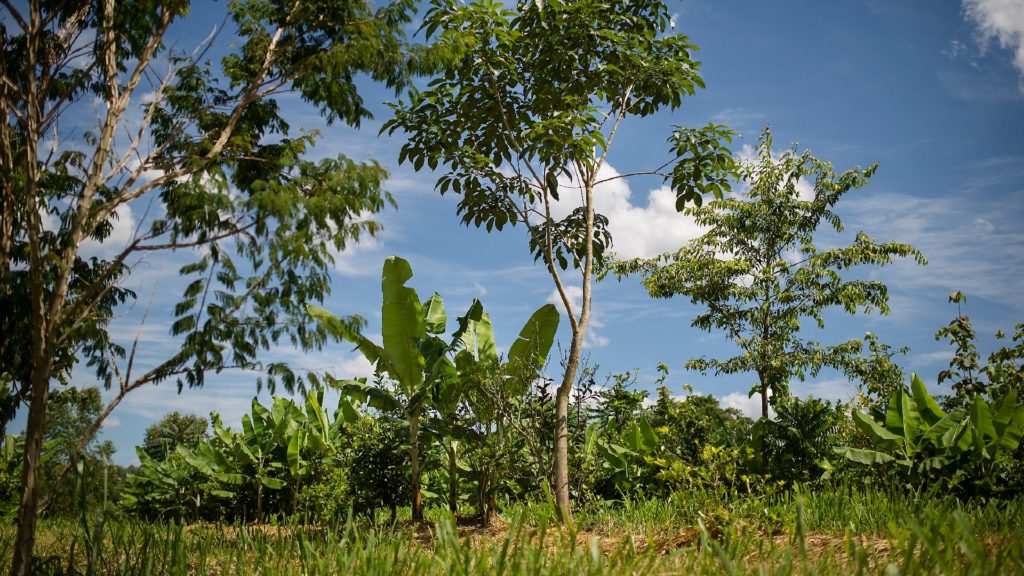
How can we replace agriculture based on chemical inputs with complex systems based on mimicking natural cycles and processes?
Our greatest challenge is to develop replicable designs, methods and management systems for regenerative agroforestry. Combining practical experience with interdisciplinary science can provide a sustainable, resilient and lasting alternative to conventional production.
To make these systems viable while preserving their biodiversity and complexity, we need to automate design, simplify processes and standardize management. This can also support food, energy and technological sovereignty.
A large-scale agroforestry production system is one that presents a technically and economically viable model, with systematized design, operations, inputs and outputs, allowing modular extrapolation, regardless of the size of the area. For systematization methods to be applied to complex, biodiverse and regenerative agroforestry systems, each component must be understood by its function, or niche, within the system rather than as an isolated species or crop.
Thus, elastic modules are created, adaptable to different realities and replicable in different geographic regions.
The popularization of systematized and open knowledge increases the dissemination of practices, the understanding of benefits and the replication of complex systems. Many people replicating means gains in scale — the paradigm shift lies in understanding the benefits and long-term social and environmental gains. Trees within agricultural systems clearly bring environmental benefits; the big challenge is to make them economically viable at scale — with a fair price, inclusive work and a final product free of pesticides and that promotes life.