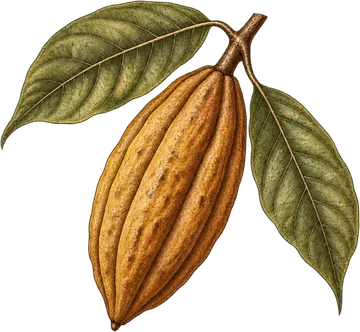
Frontispiece

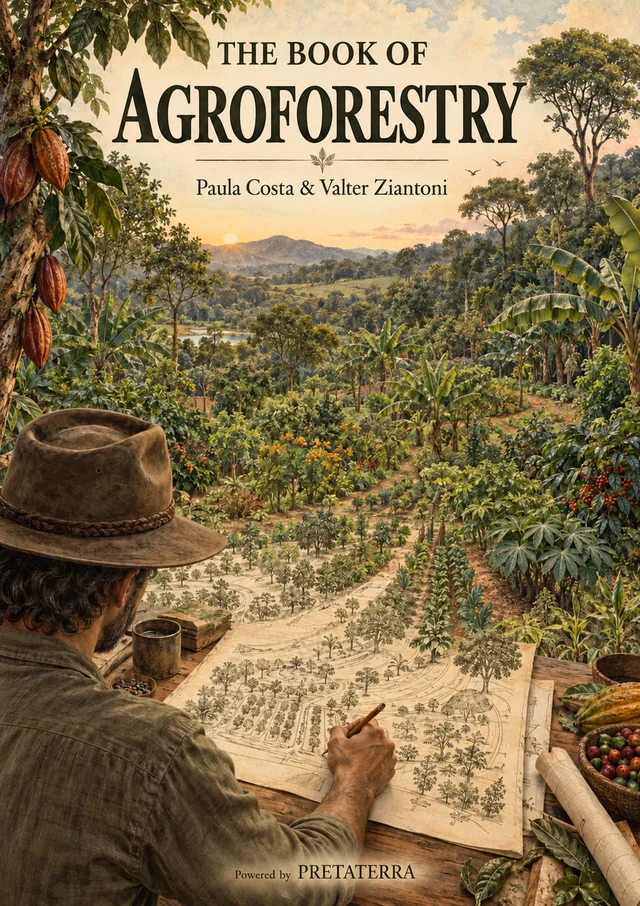
Cover of The Book of Agroforestry, by Paula Costa and Valter Ziantoni: a farmer draws the plan of an agroforest in front of the landscape.
Plate IThe Book of Agroforestry · cover of the PDF edition

✦ English edition · a PRETATERRA e-book ✦

THE BOOK OFAgroforestry

by Paula Costa & Valter Ziantoni

The method PRETATERRA used to design more than 200 agroforests in 22 countries, laid out so you can design your own: from the first sketch to cash flow.

  • 300+pages
  • 9design principles
  • 20establishment steps
  • 3real case studies

$25one-time payment in US dollars · PDF e-book

Get the book

Secure checkout by Hotmart7-day money-back guarantee

MMXXVI

A first of its kind

The first book to bring together the modern schools of farming.

Regenerative agriculture, agroforestry, syntropy and permaculture usually live in separate books, courses and camps. Here they meet, with the logic that links one to the next.

  • Regenerative agricultureProducing while regenerating soil, water and biodiversity, instead of depleting them.Regenerative Agroforestry, p. 163
  • AgroforestryFarming with trees: succession, strata and biodiversity in the service of production.Agroforestry, p. 34
  • SyntropyErnst Götsch's process agriculture, with its practical principles and the pulse created by pruning.Ernst Götsch's Syntropy, p. 106
  • PermacultureZoning, natural building and water management to organize the whole property.Permaculture, p. 55

✦ With the book, you'll know how to ✦

  1. IProduce at scaleEstablish and scale agroforests that feed people, with mechanizable rows and cash flow.
  2. IIRestoreBring degraded landscapes back with succession, service species and soil that is always covered.
  3. IIILive from the landBuild your own self-sufficient property, from zoning to selling the surplus.

Why this book

Agroforestry seems too complex to turn into a project. With a method, it isn't.

“To design a productive agroforestry system is to design a living organism; this book will guide you deep into that process.”
From the prologue

ErrataFor · read

  1. I

    ForWhat product do we need to apply?

    ReadWhich process is missing? Which process has been interrupted? How can we restore it?

    The shift from input agriculture to process agriculture, at the heart of Ernst Götsch's syntropy.

  2. II

    ForPlanting by improvisation, one bed at a time.

    ReadPlan 1 hectare and replicate the module across 10.

    Seedlings, labor days, inputs and tractor hours calculated per module, with parallel rows that machines can work.

  3. III

    ForMistaking a plant's height for its stratum.

    ReadDesign the light, time and space of every species.

    Succession, stratification and canopy architecture become design rules, with shade percentages for each stratum.

  4. IV

    ForTechnique without vision, or philosophy without practice.

    ReadBoth in a single volume.

    From the manifesto of ancestralism to cash flow: why to practice agroforestry and how to make it work.

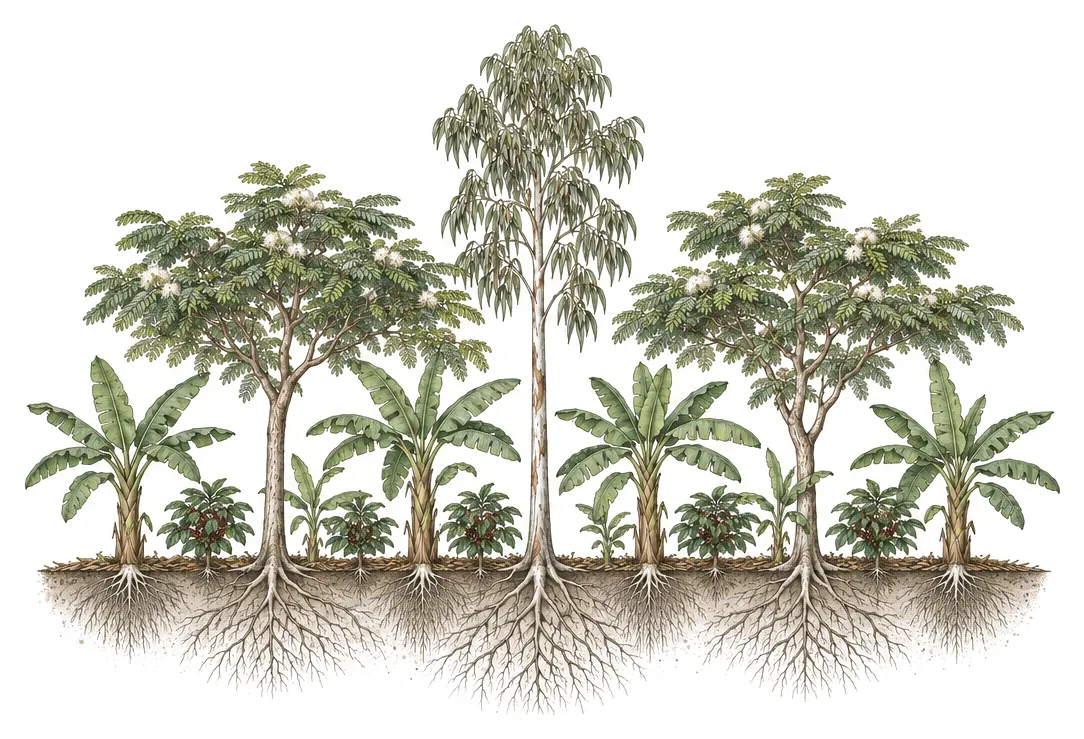
Engraving of an agroforestry row in cross-section, with eucalyptus, inga, banana and coffee, and their roots in the soil.
Plate IIOne row, four strata: eucalyptus, inga, banana and coffee. Height is not the stratum.

What's inside

From concept to cash flow, in 7 parts.

The chapters were written to be read in any order. Start with what you need today and come back to the rest when your agroforest calls for it.

  • 300+pages
  • 7parts, from concepts to case studies
  • 9design principles
  • 20establishment steps
  • 11worked calculations
  • 3real case studies
  1. PartI
    Introducing Concepts15The tree, the forest and agriculture, leading up to the definition of agroforestry: farming with trees.
    1. The Tree16
    2. The Forest22
    3. Agriculture29
    4. Agroforestry34

    ☞It starts with the basics: what a tree, a forest and an agroforest are.

  2. PartII
    A Little of Everything You Need to Know44The ideas behind agroforestry: ancestral knowledge, permaculture, carbon, terra preta and syntropy. 14 chaptersclose
    1. Ancestralism — A Manifesto45
    2. Permaculture55
    3. Small Communities and Distributism61
    4. The Land Ethic and Aristotle's Household Economy66
    5. Man and Nature72
    6. Carbon82
    7. Hunter-Gatherers, Ancestral Management and Terra Preta95
    8. Ernst Götsch's Syntropy106
    9. Trophobiosis and the Gaia Hypothesis135
    10. Resilience141
    11. The Dawn of Agriculture: Our Legacy and Future147
    12. The Holistic Understanding of Biodynamics153
    13. Biological Transmutation157
    14. Regenerative Agroforestry: The Path to a Prosperous Future163

    ☞The part about “why”: from Amazonian terra preta to Ernst Götsch's syntropy.

  3. PartIII
    The Foundations of Agroforestry167Succession, strata, canopy architecture, timber, pruning, pulse and service species.
    1. Succession, Stratification and Canopy Architecture168
    2. The Tree in the Production System: Concept, Architecture and Timber174
    3. Pruning and Pulse in Agroforestry184
    4. Service Species191

    ☞Read pages 171 and 172 a little further down, in the open book.

  4. PartIV
    Principles of Agroforestry Design Engineering198The 9 principles of the PRETATERRA method for designing systems that are unique, replicable and mechanizable. 9 chaptersclose
    1. Correlation201
    2. Adherence204
    3. Modularity207
    4. Replicability212
    5. Functional Niche214
    6. Elasticity217
    7. The Temporal Decision Component219
    8. Synergy221
    9. Graphic Representation of Agroforestry225

    ☞The heart of the method: “the foundation of the PRETATERRA method and algorithm.”

  5. PartV
    Principles Applied in Practice227From choosing species to placing them in niches: spacing set by the machinery, the primary composition and the diversification matrix.
  6. PartVI
    Hands in the Soil: Step-by-Step Establishment241A 20-step checklist, from marking out the area to cash flow, with doses and calculations.

    ☞11 worked calculations, from crown area to irrigation.

  7. PartVII
    PRETATERRA Case Studies270Three real systems you can visit, in three different value chains.
    1. Case 1: White Pepper Agroforest272
    2. Case 2: Agroforestry Cacao in Bahia279
    3. Case 3: Living Pasture286

    ☞Indonesia, Bahia and Mato Grosso.

  1. Afterword289
  2. Further Reading: the references for each chapter294
  3. PRETATERRA: Vision, Journey and Founders306

Leaf through a few pages

Open the book before you buy it.

Turn the pages of the e-book: the contents, the prologue, the hand-drawn illustrations and pages 171 and 172, with the shade rule for each stratum that sets the spacing of your system.

Cover of The Book of Agroforestry.
Title page: The Book of Agroforestry, by PRETATERRA.
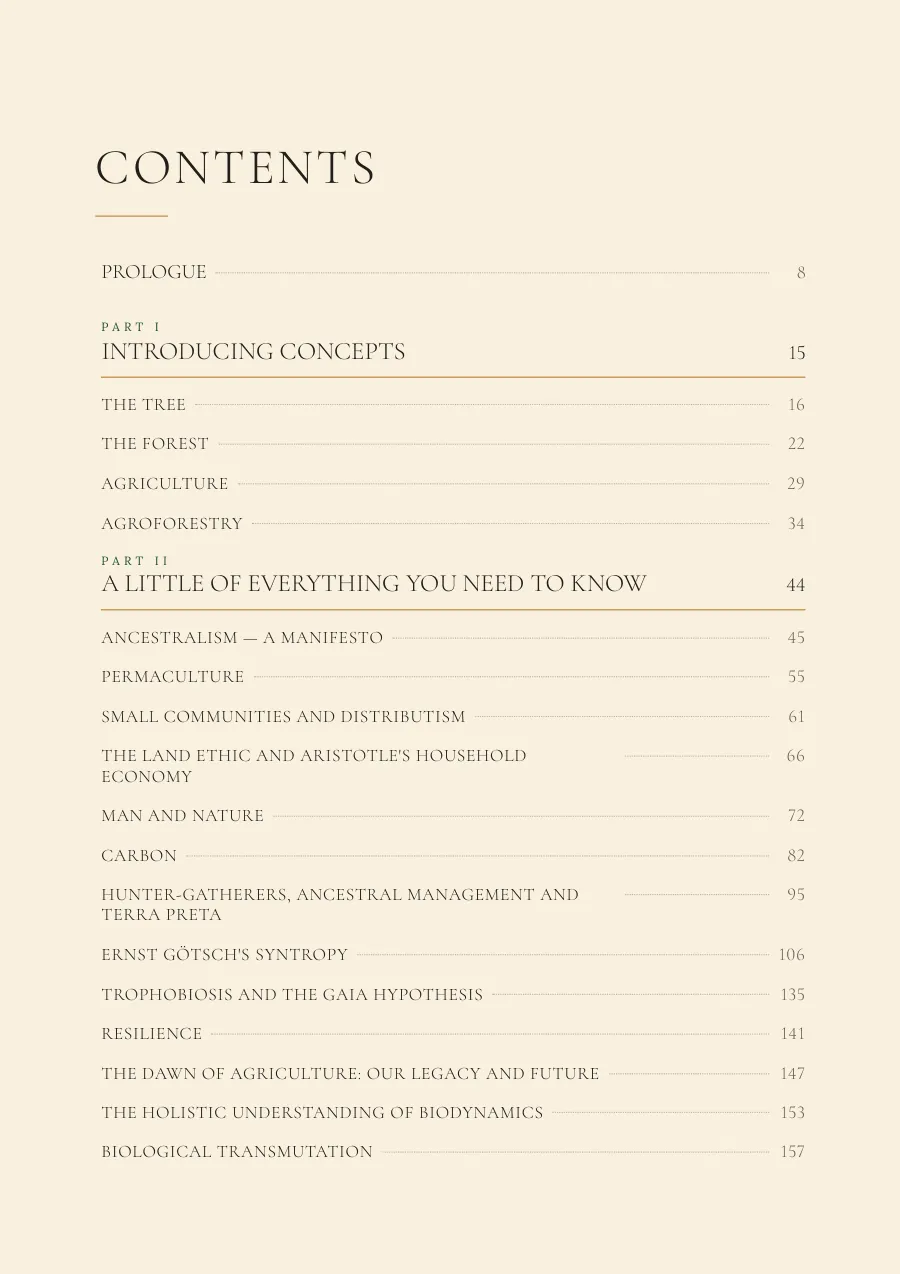
Table of contents, from Part I to Part II.
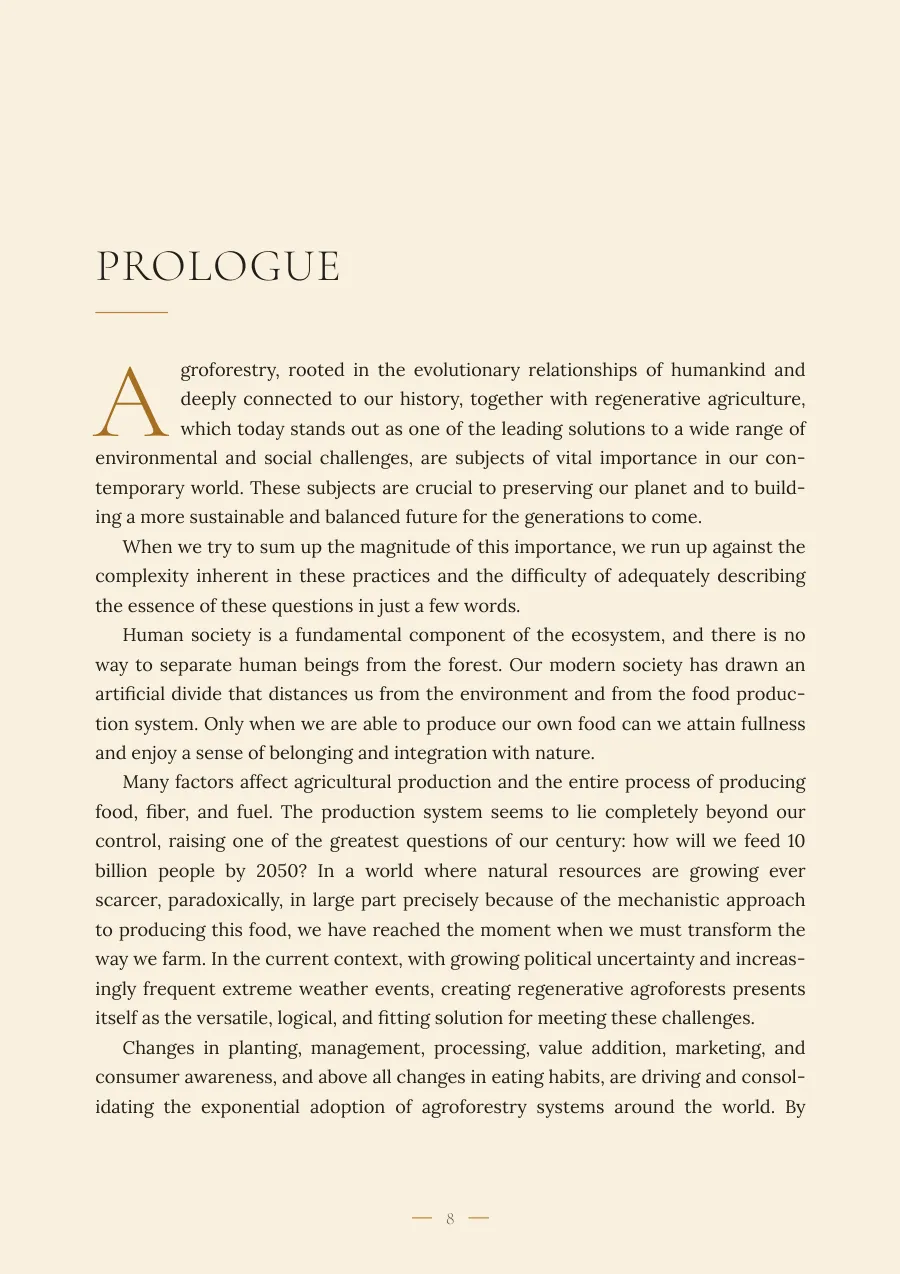
First page of the prologue.
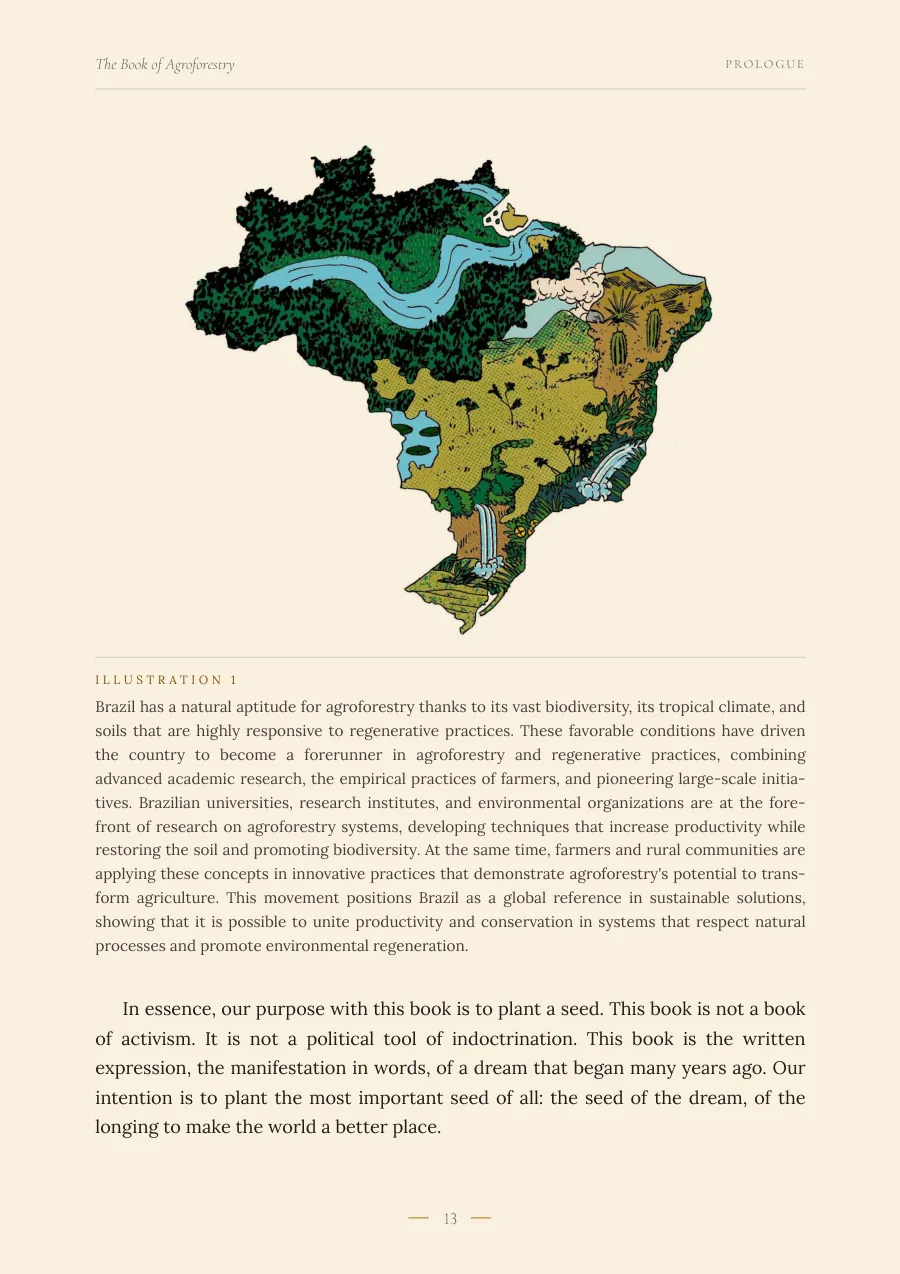
Prologue page with the illustration of Brazil and its biomes.
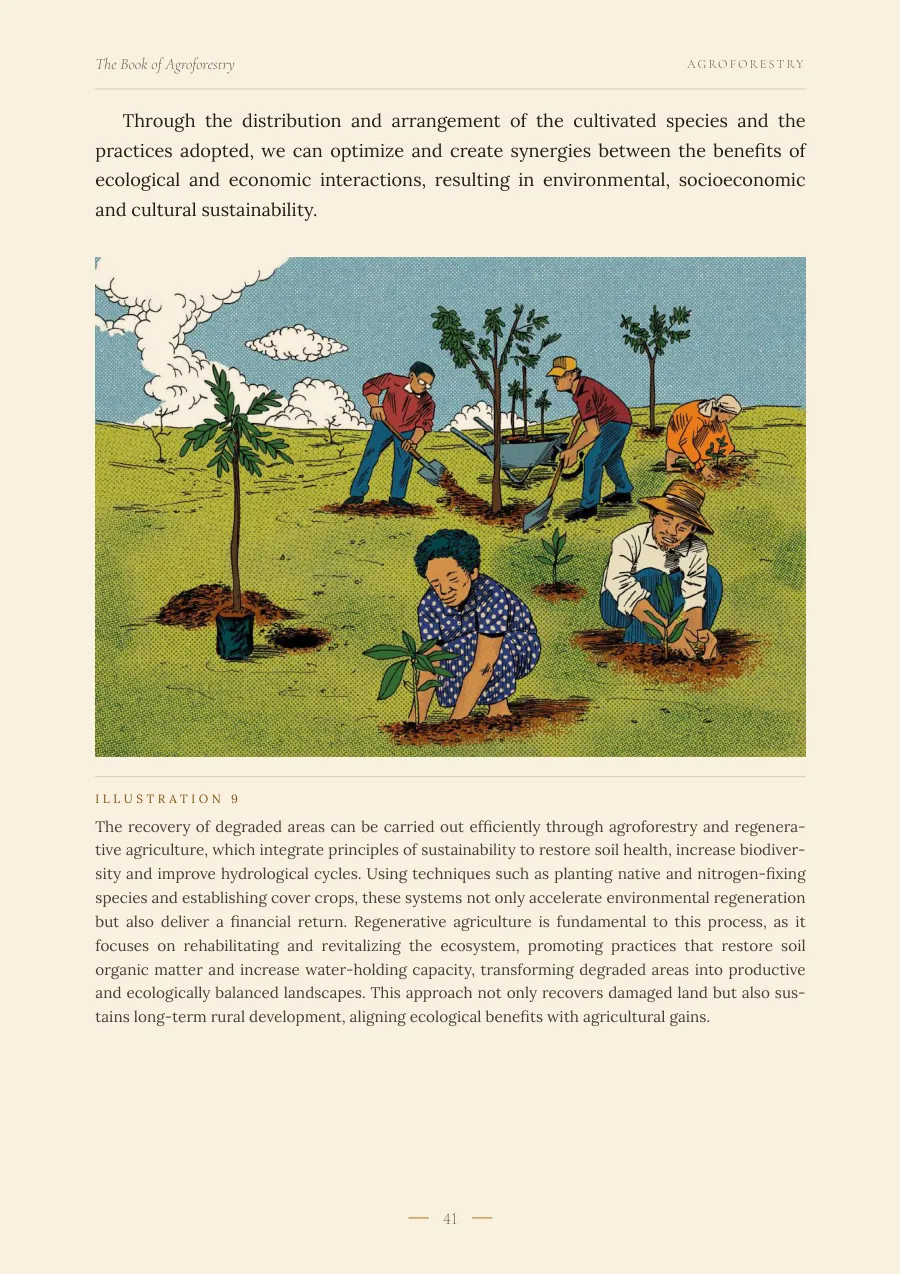
Illustration of farmers planting seedlings on degraded land.
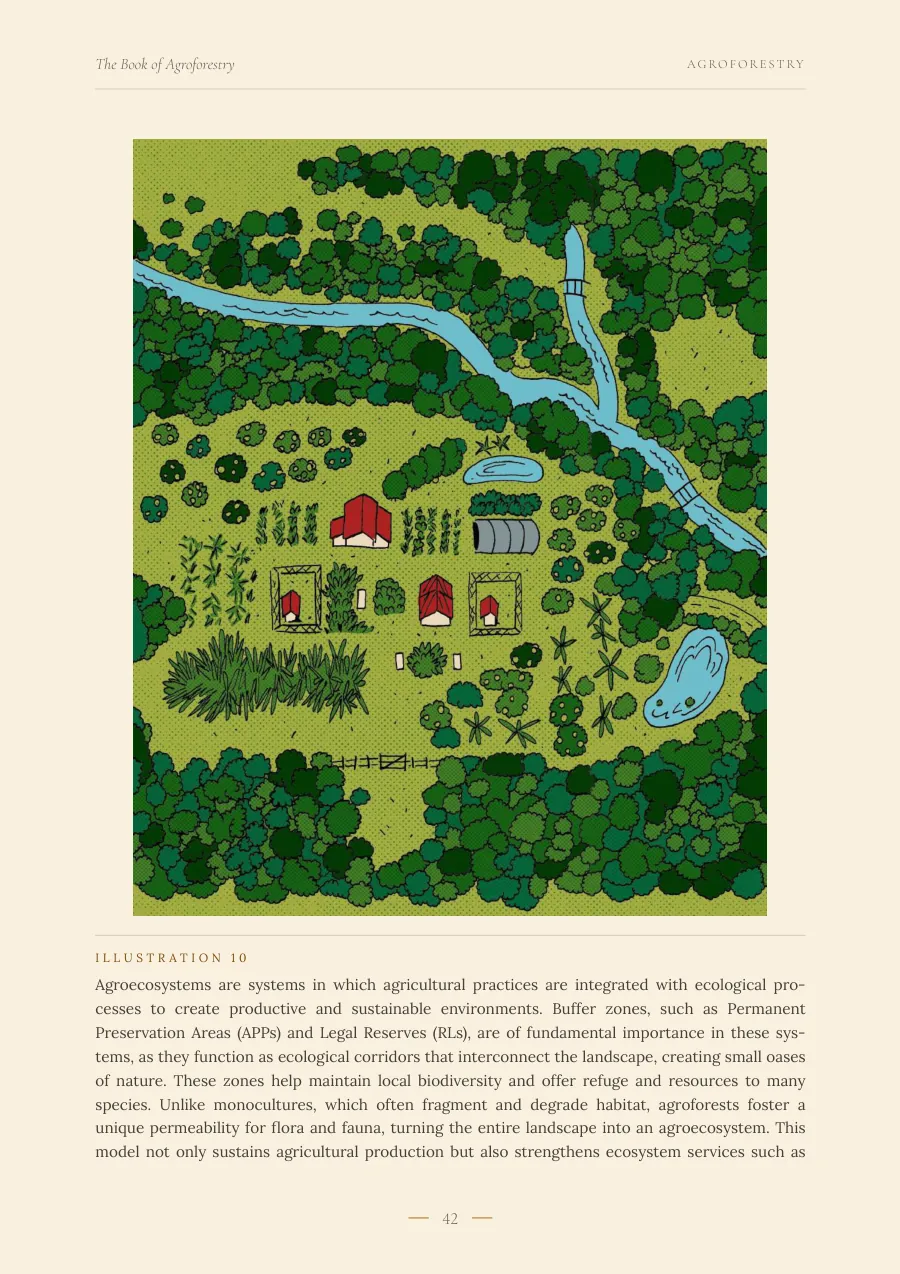
Illustration of a landscape with agroforests, a river and protected areas, seen from above.
Opening of Part III: The Foundations of Agroforestry.
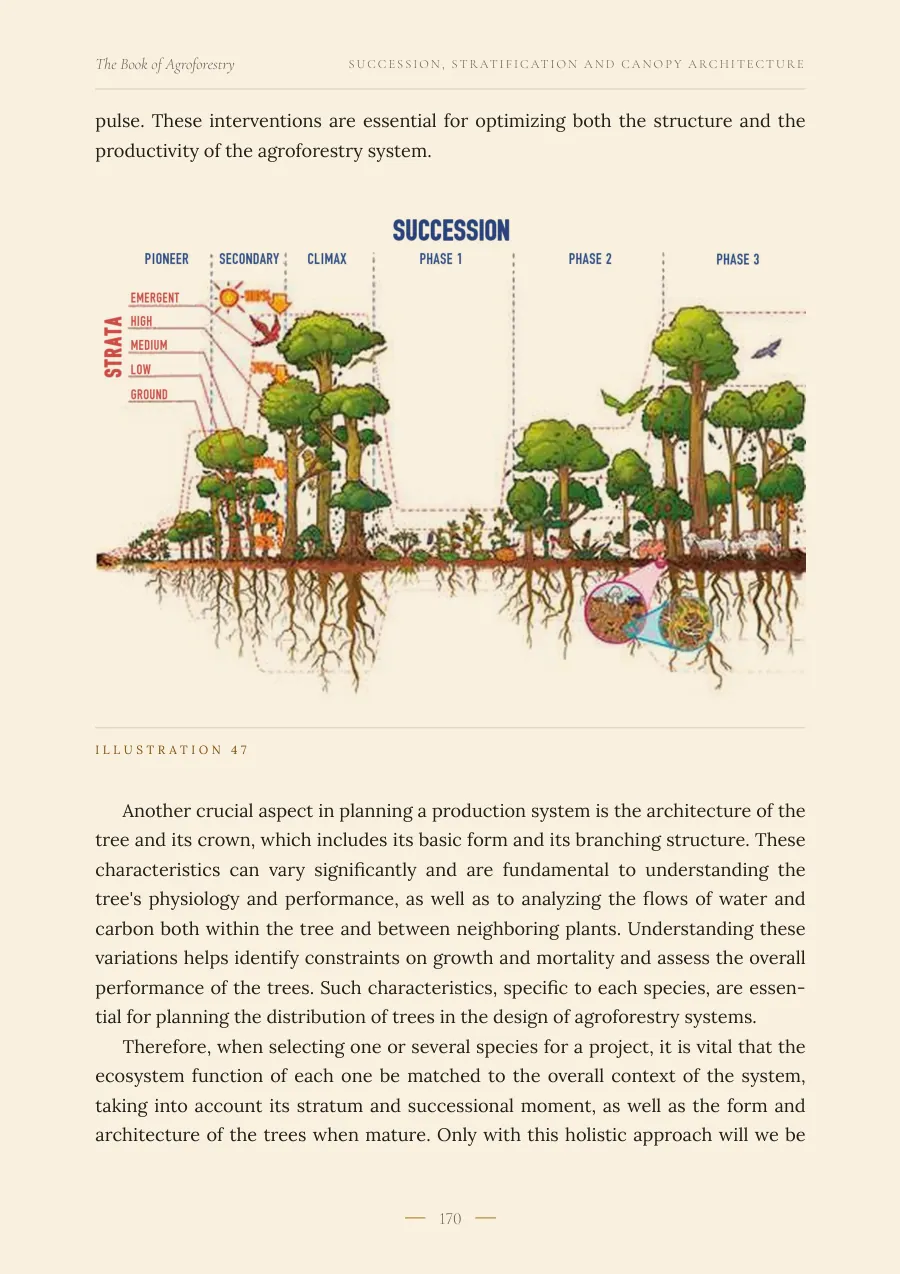
Diagram of agroforest succession in phases and strata.
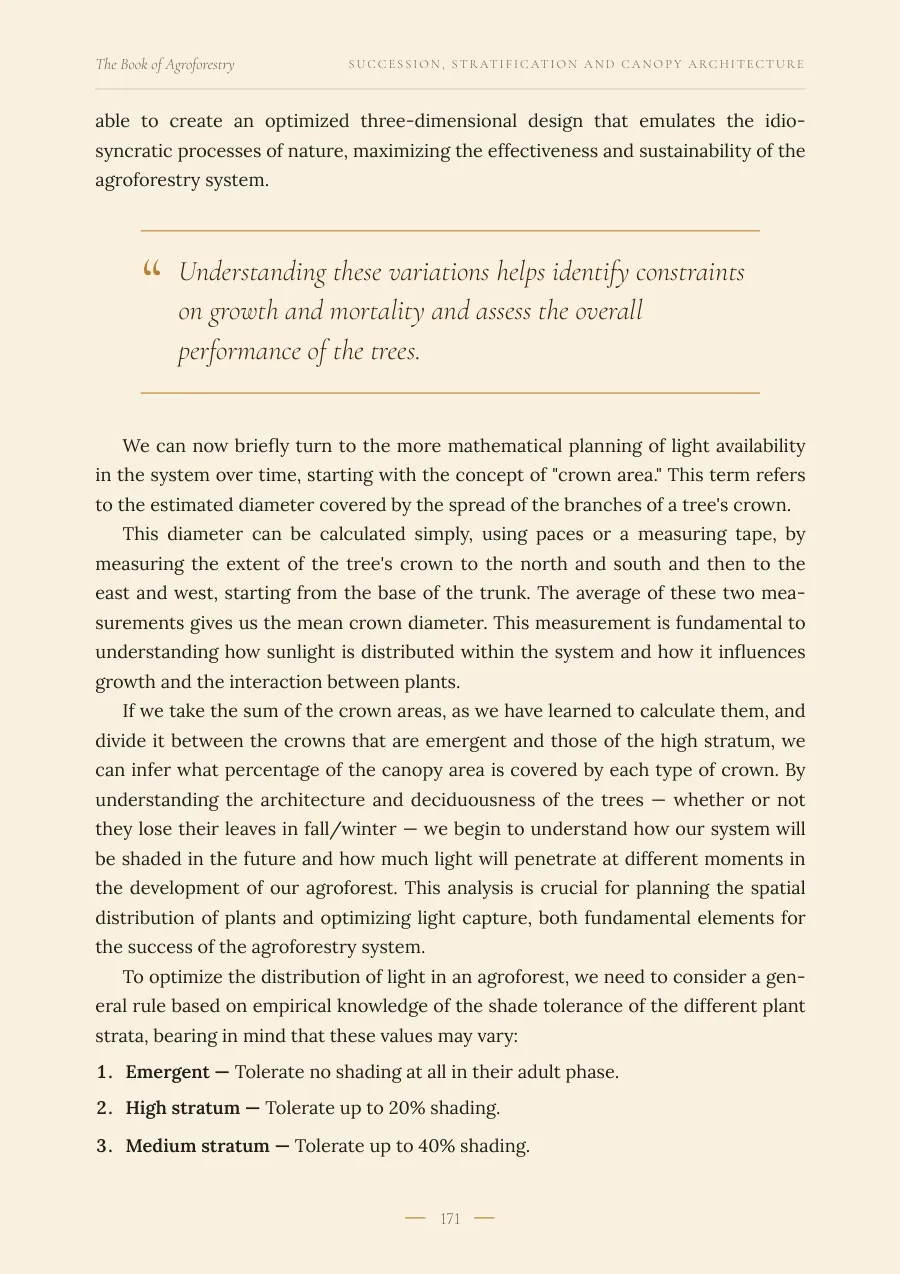
Page on shading by stratum, with the rule for the emergent, high and medium strata.
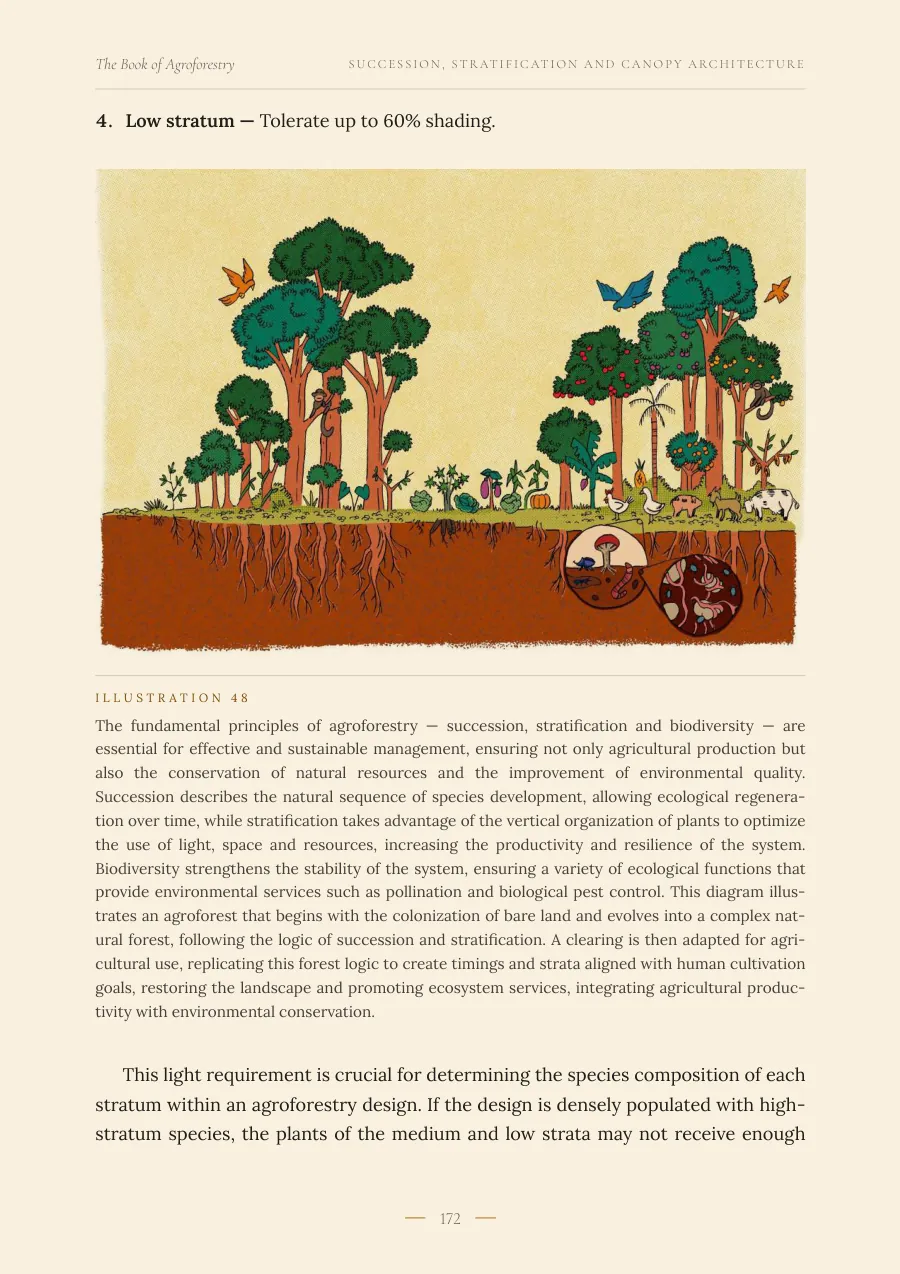
Illustration of the strata of an agroforest, with the rule for the low stratum.
Opening of Part IV: Principles of Agroforestry Design Engineering.
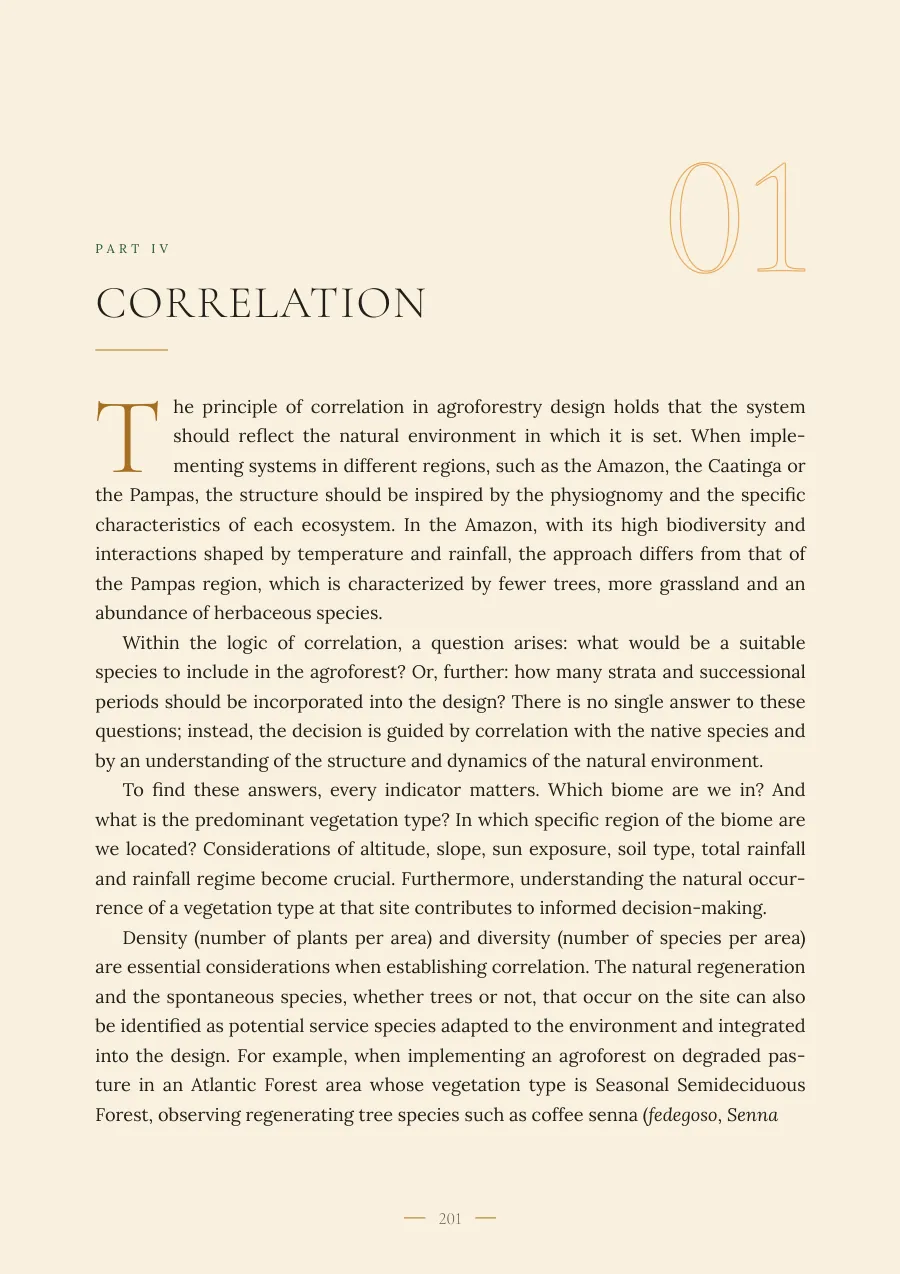
Opening of the Correlation chapter, the first principle of the method.
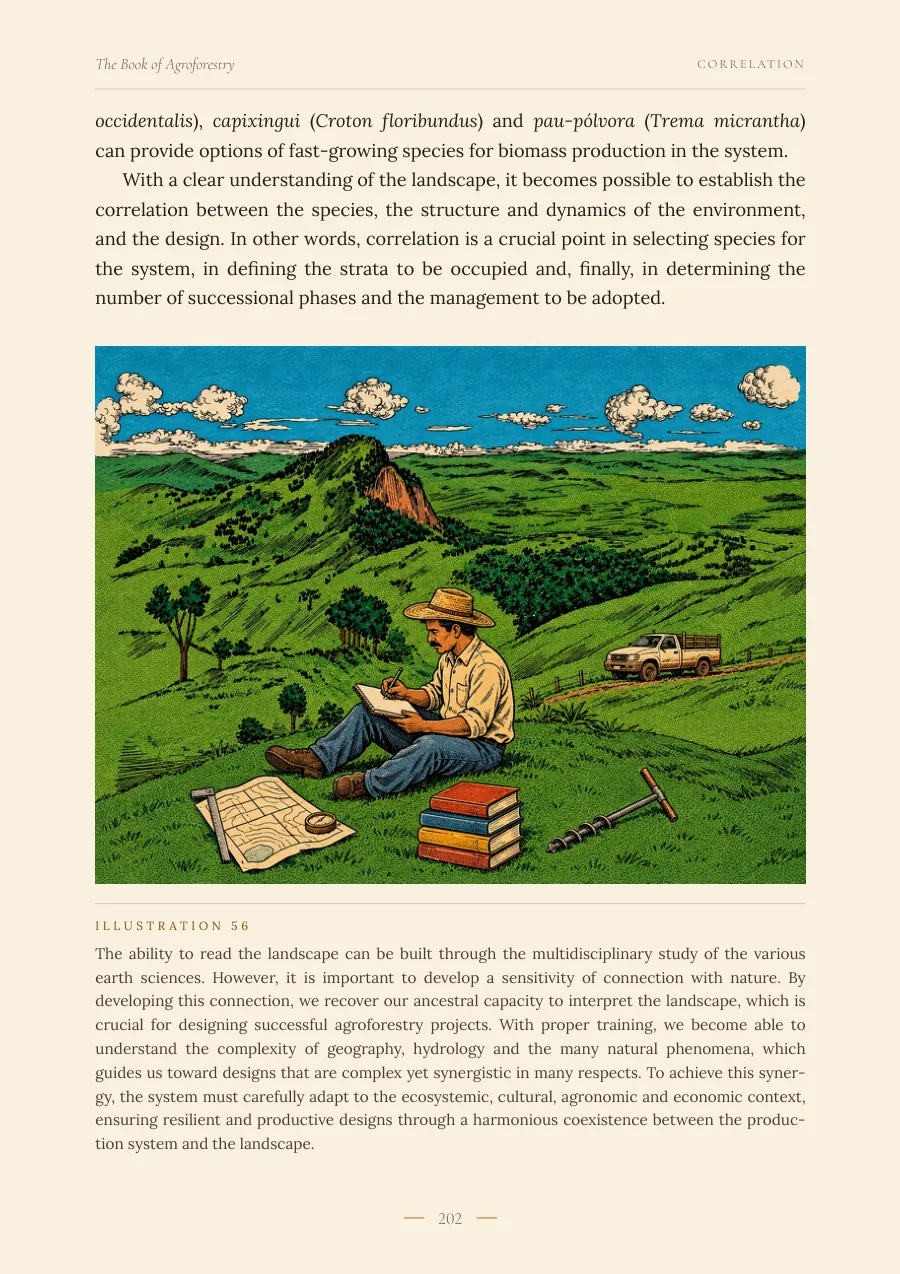
Illustration of a farmer in a straw hat taking notes on the design in front of the landscape, with a pickup truck in the background.
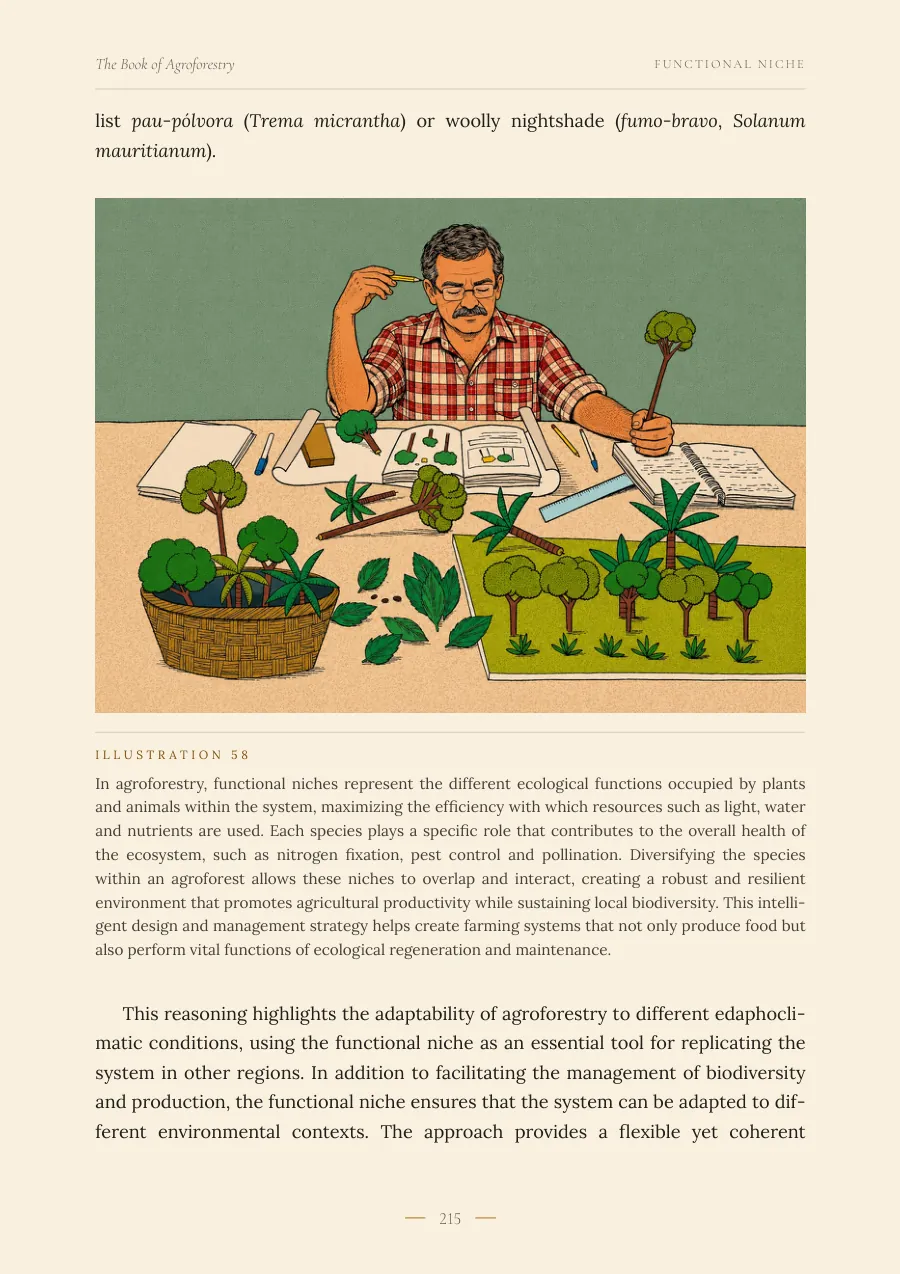
Illustration from the Functional Niche chapter: a farmer sorts seedlings by function.
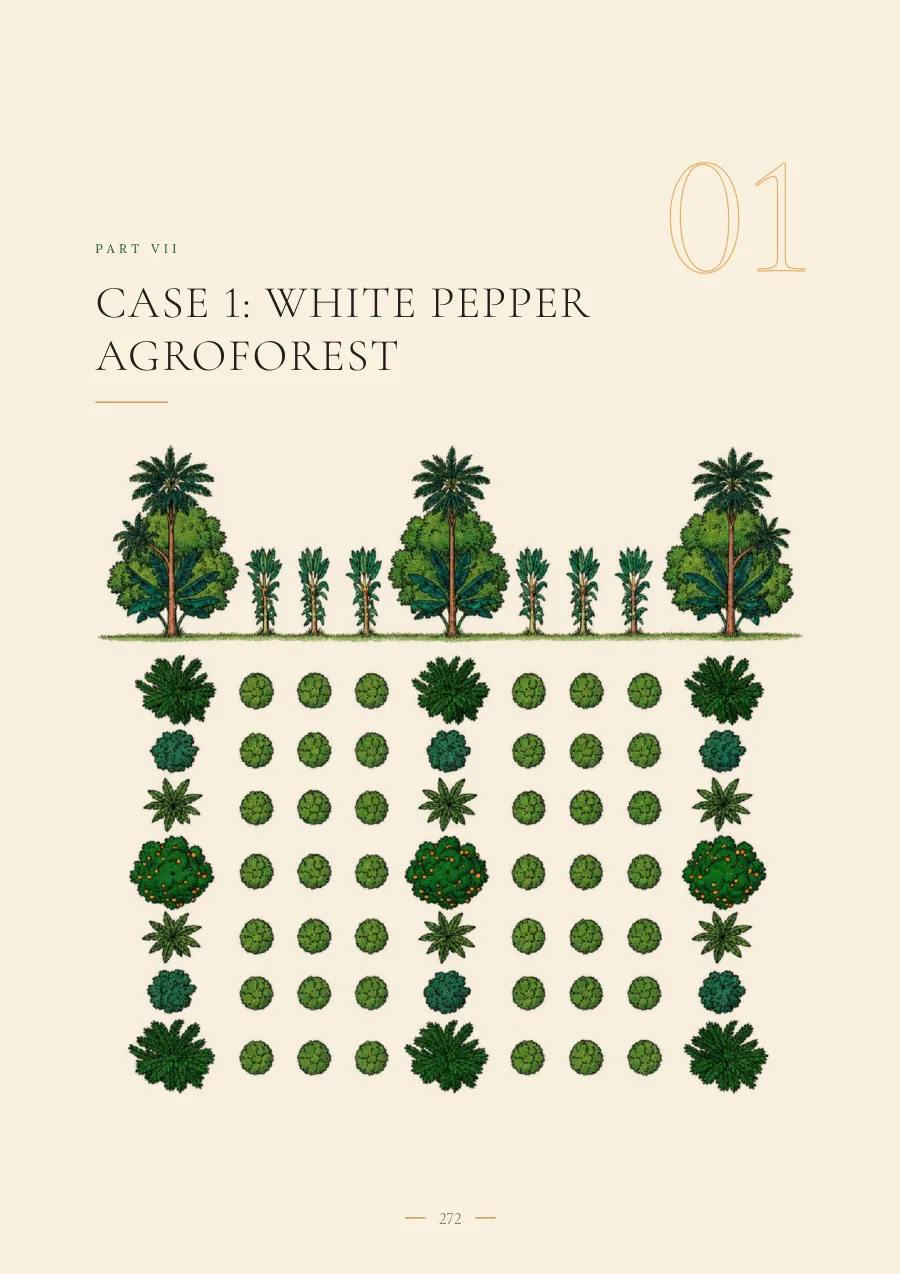
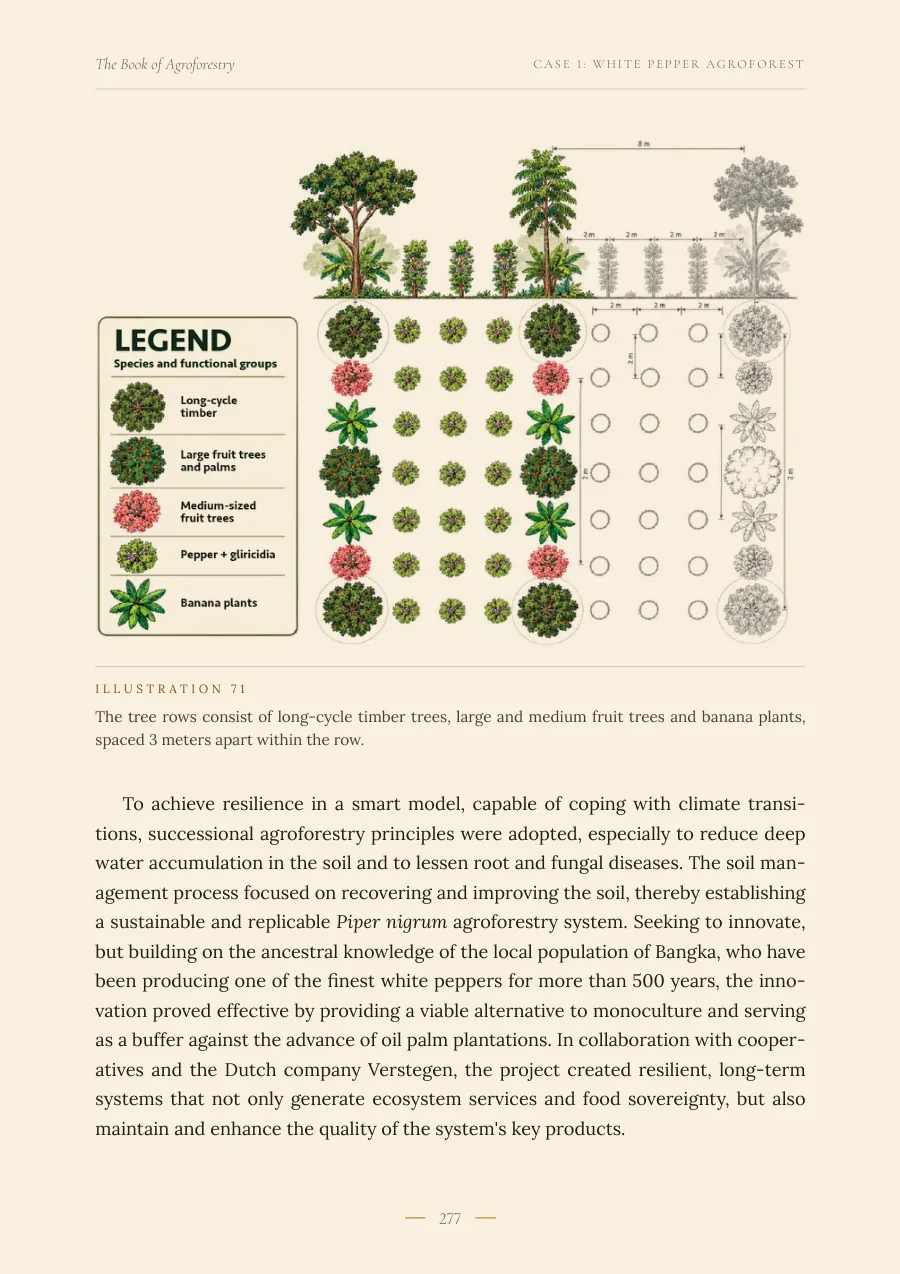
Opening of Case 1, the white pepper agroforest, with the drawing of the rows.
Technical drawing of the Case 1 rows, with the species legend by functional niche.
The first book to bring together regenerative agriculture, agroforestry, syntropy and permaculture.

Paula Costa · Valter Ziantoni

$25

Get the book

1 of 10Cover

Real pages from the PDF e-book. Drag, click the page or use the arrow keys.

Part IV · The PRETATERRA method

9 principles for designing agroforests that work at any scale.

Agroforestry calls for creativity, but a commercial system calls for a standard: parallel rows, machinery and a revenue forecast. The nine principles of agroforestry design engineering bring the two together.

  1. I

    Correlation

    The design mirrors the local ecosystem: biome, soil, rainfall, density and the species already regenerating there.

  2. II

    Adherence

    The system fits the culture and know-how of the people who will manage it, with 7 adoption indicators and 8 monitoring indicators.

  3. III

    Modularity

    Everything is planned per hectare: seedlings, labor days, inputs and machine hours. To grow, you replicate the module.

  4. IV

    Replicability

    Tested modules carried to new areas and scales, with arrangements that are easy to memorize in the field.

  5. V

    Functional niche

    Species grouped by function, stratum and cycle, and interchangeable within the niche. A strategy developed by PRETATERRA.

  6. VI

    Elasticity

    The design adapts to the climate, the soil and the farmer's preferences without losing its logic.

  7. VII

    The temporal decision component

    Decision points planned from the very first design, to reassess the system in light of markets, climate and labor.

  8. VIII

    Synergy

    Companion and antagonistic plants: the yield of the whole area greater than the sum of monocultures.

  9. IX

    Graphic representation

    Sketches for each phase of succession, with colors, icons and legends, like the floor plan of a house.

“These nine principles form the foundation of the PRETATERRA method and algorithm, an effective and innovative means of conceiving unique agroforestry designs of excellence, now available to you.”
— Part IV —

PRETATERRA's complete method for $25.

A PDF e-book to read on your phone, tablet or computer.

$25

Get the book

Part VI · Hands in the soil

The whole establishment, in 20 steps.

From marking out the area to cash flow, with doses, spacing and the math worked out on the page, so you can redo it with the numbers from your own land.

  1. 1Delimiting the area
  2. 2Foundation green manuremuvuca, cassava and pigeon pea as biological subsoilers
  3. 3Mowing the entire area
  4. 4Ant controlliquid cassava residue, neem, cashew nut shells and sesame
  5. 5Chisel plowing and soil preparation
  6. 6Limestone and gypsum2 t + 1 t per hectare, adjusted to the pH
  7. 7Fertilizing the entire areanitrogen content of 9 organic fertilizers
  8. 8Logistics and labor
  9. 9Marking out the rowseast to west, with contour lines taking precedence
  10. 10Subsoiling along the rows
  11. 11Planting holes
  12. 12Planting the seedlings
  13. 13Service species
  14. 14Sowing the seedsmuvuca with 5 times the final density
  15. 15Covering the soil
  16. 16Post-planting fertilizationdoses per plant, organic and conventional
  17. 17Irrigation2 L per plant per week, with tank and hose sized
  18. 18Pruning and managementfor biomass, timber and fruit
  19. 19Monitoringprotocol and indicators
  20. 20Productivity, revenue and cash flow

11 worked calculations throughout the book

  • Crown area
  • Timber volume
  • Plot-based inventory
  • Carbon per tree
  • Yield per plant
  • Labor per hectare
  • Spreader calibration
  • Limestone and gypsum by pH
  • Manure per planting hole
  • Muvuca seed mix
  • Irrigation

Part VII · PRETATERRA case studies

Three real systems you can visit, from pepper to cattle.

Chosen because they differ from one another: another continent, another value chain, another scale. Each one with its design, spacing and functional niches.

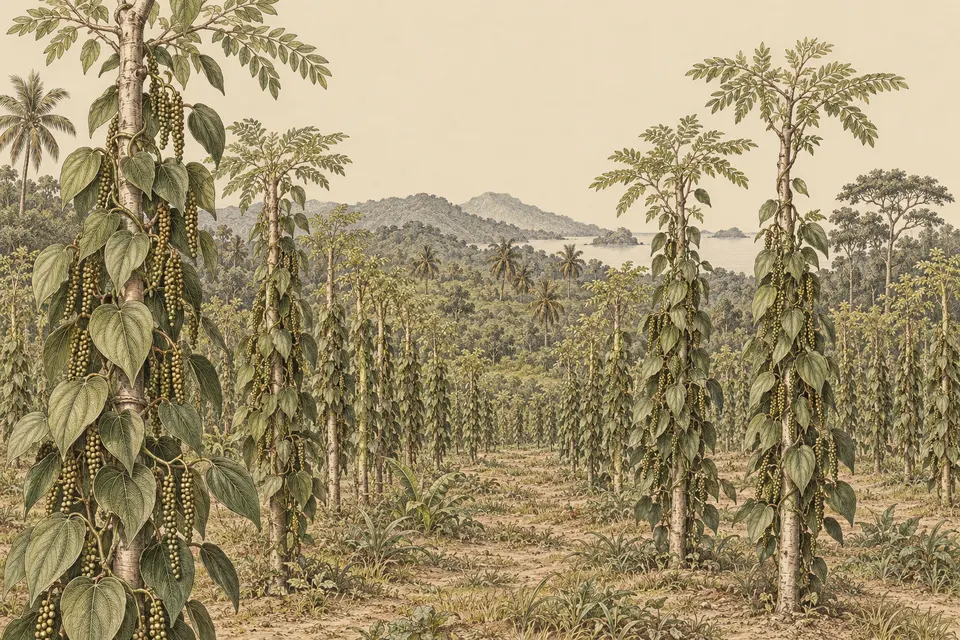
Engraving of pepper vines climbing live gliricidia stakes, with hills and the sea in the background.

Case 1 · Indonesia

White pepper on Bangka Island

Organic white pepper on live gliricidia stakes, as an alternative to the advance of oil palm. Built with local cooperatives and the Dutch company Verstegen.

  • 10 functional niches
  • No artificial fertilizers
  • 2,514 mm of rain a year
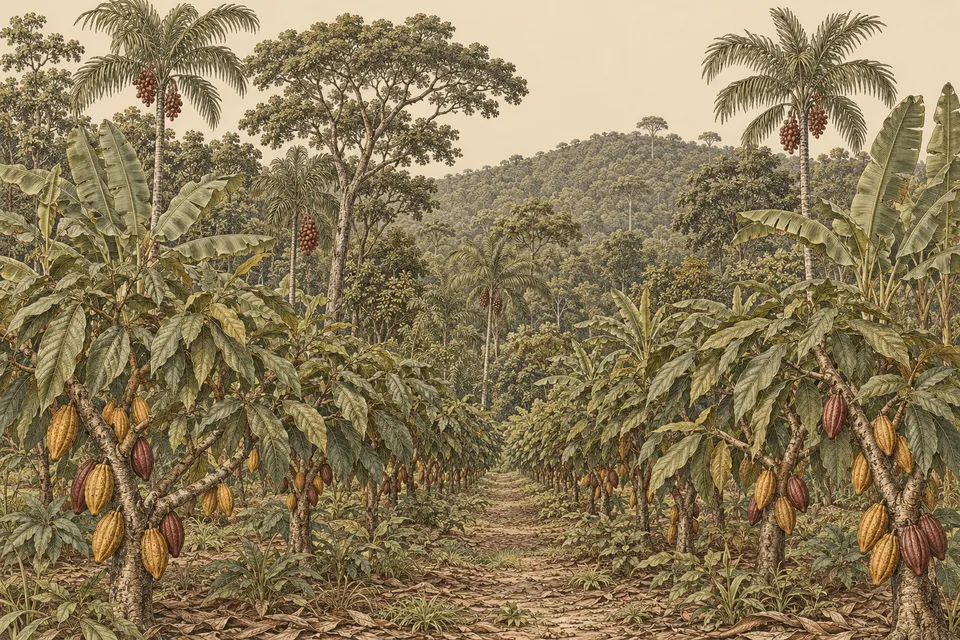
Engraving of rows of cacao trees with pods on the trunks, under peach palms, banana plants and tall trees.

Case 2 · Bahia

Agroforestry cacao in Itagi

Where the Atlantic Forest meets the Caatinga: rows of trees and fruit, double cacao rows with ginger, and peach palm rows with banana and taro.

  • 3 row types
  • Detailed spacing
  • Products valued as agroforestry-grown
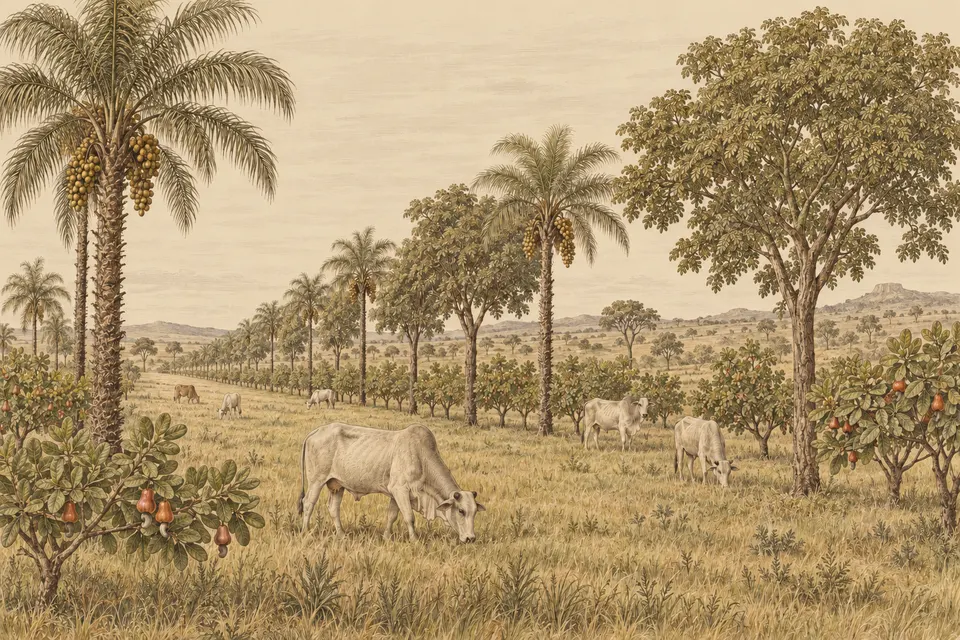
Engraving of cattle grazing between belts of macaúba, baru and dwarf cashew in the Cerrado.

Case 3 · Mato Grosso

Living Pasture (Pasto Vivo)

Agroforestry livestock financed by investment groups: grains in the first years and, from year 4, cattle under dwarf cashew, macaúba, baru and aroeira.

  • 1,200 hectares
  • 8 m belts, 30 m alleys
  • 9 functional niches

Part II · More than a manual

Not just a technical manual. A philosophical journey.

The book traces the history of agroforestry practices, from the ancestral management that created the Amazon's terra preta to Ernst Götsch's process agriculture, to show how the forest can be “hacked” into regenerative systems that pay for themselves. That is what gives the design its meaning.

The wisdom of a society is revealed in land that remains fertile after the harvest and in the autonomy of those who inherit it.
Man and Nature, p. 81
  • Ancestralism45
  • Biodynamics153
  • Carbon82
  • Distributism61
  • Ernst Götsch's syntropy106
  • Gaia hypothesis135
  • Land ethic66
  • Permaculture55
  • Regenerative agriculture163
  • Resilience141
  • Terra preta95
  • Trophobiosis135

The themes of Part II, with the page of each chapter.

Who it's for

For anyone who wants to plant with a method.

Students, farmers, technicians, academics and enthusiasts: everyone who wants to take part in transforming our food system.

  • Complete beginnersThe chapters can be read in any order and start with the basics: what a tree, a forest and an agroforest are.
  • Farmers in transitionA guide to moving away from monoculture without reinventing the wheel: start simple, with the species and the know-how of the place.
  • Technicians and consultantsA method to design, budget and follow up on clients' systems, with adoption and monitoring indicators.
  • Anyone after scaleMechanizable rows, per-hectare modules, yield per plant and cash flow, from 2 to 1,200 hectares.
  • Dreamers headed for the landFrom zoning a small property to planning your own move from the city to the countryside.
  • Readers anywhere in the worldBrazil is the starting point, but the method travels: a case study in Indonesia and a principle, the functional niche, made to carry a design from one biome to another.

Who wrote it

Paula Costa and Valter Ziantoni, founders of PRETATERRA.

Two forest engineers who have devoted their careers to designing agroforests, from Fazenda da Toca, in the São Paulo countryside, to Bangka Island, in Indonesia.

Valter Ziantoni

Agroforestry designer · co-founder

Forest engineer from the Federal University of Paraná (UFPR), with a master's in Agroforestry from Bangor University and a specialization in Circular Economy from MIT. More than 25 years of experience, projects in Africa and Asia and more than 100 countries visited. He coordinated the agroforestry project at Fazenda da Toca.

LinkedIn →

Paula Costa

Forest engineer and biologist · co-founder

Forest engineer from ESALQ-USP, biologist from UNESP and specialist in Environmental Management. Awarded by the Brazilian Society of Silviculture in 2016. She has coordinated large-scale agroforestry systems and lived in the Amazon, learning from native peoples.

LinkedIn →
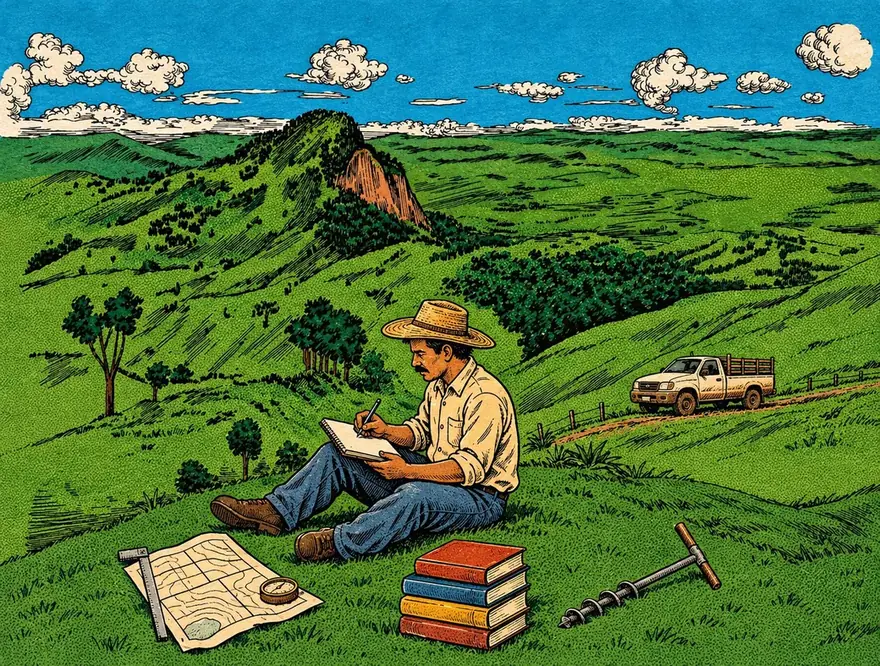
Engraving of a farmer in a straw hat sketching a design on a hillside, with a map, books and a soil auger beside him and a pickup truck in the distance.
Plate IIIReading the landscape before drawing the design. From the chapter on correlation.

Illustrations lovingly handcrafted by Estúdio Arado · Layout by Lorena Cotrim

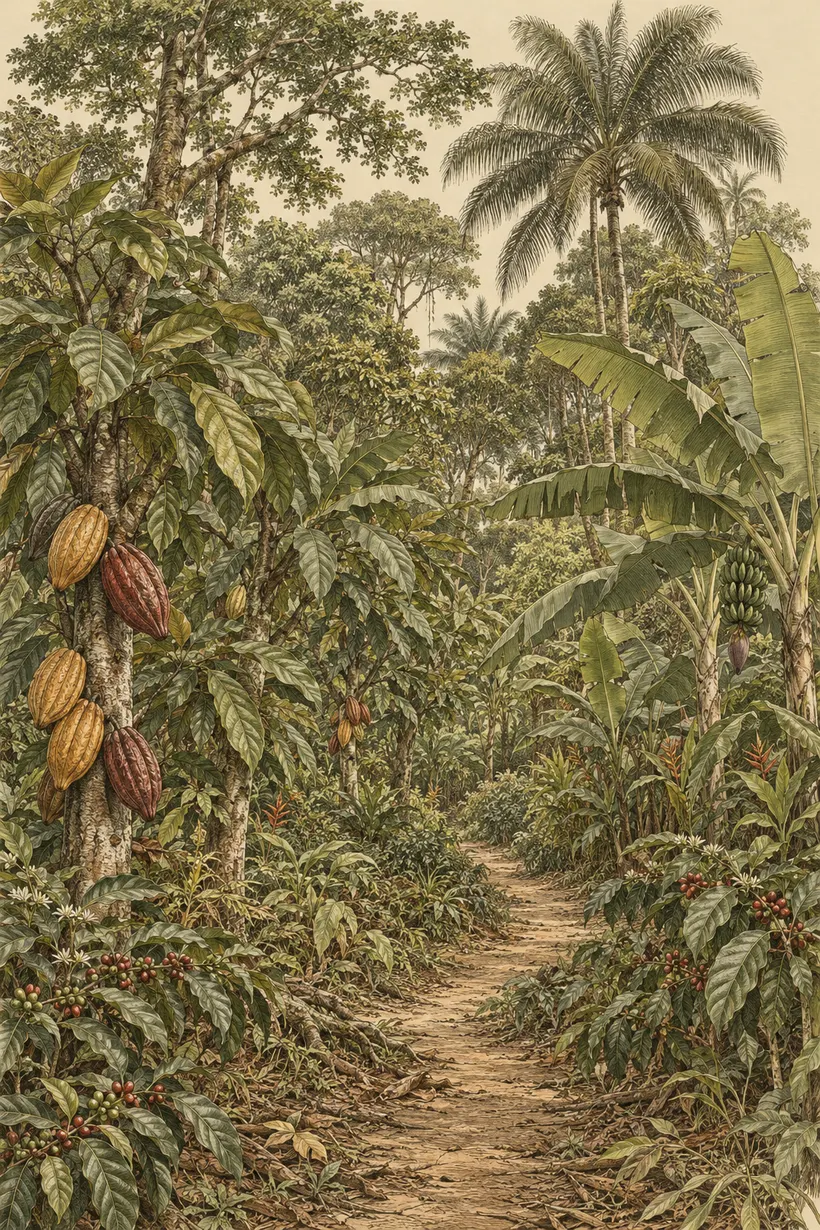
Engraving of a mature agroforest seen from a trail, with cacao, coffee, banana plants, palms and tall trees.
Plate IVA mature agroforest, from the trail to the canopy.

From the afterword · a letter from the authors

From the very beginning, we set out a challenge: to rethink our relationship with the Earth and with the systems that sustain our existence. We discussed how agroforestry is not just a farming technique but a philosophy of life, a way of reconnecting with natural cycles and with the ancestral wisdom that governs the balance of our planet.

Agroforestry is a response to the call of the Earth, a call to heal the wounds we have inflicted on it, and on ourselves, through unsustainable practices. […] The future is an open book, and you hold the seed to plant the next chapter.

With hope and admiration,Valter and Paula

The method behind projects for the World Bank, Nestlé and Armani.

Since 2017, PRETATERRA has designed agroforests for funds, governments and major brands. The book gathers what worked in the field into a method you can apply on your own land.

PRETATERRA clients

World Bank GroupArmaniLVMHNestléCargillNaturaDengoUBS Optimus FoundationFAO
  • 200+systemsagroforestry systems designed and established by PRETATERRA.
  • 22countrieswith projects in the field, from Indonesia to Mato Grosso.
  • 100,000+hectaresof project area, between 2017 and 2025.

What you get

The Book of Agroforestry, complete.

  • A PDF e-book of more than 300 pages
  • 7 parts, from concepts to establishment and case studies
  • The 9 principles of PRETATERRA's design method
  • A 20-step establishment checklist
  • 11 worked calculations and 3 real case studies
  • More than 170 references, organized by chapter
  • Hand-drawn illustrations by Estúdio Arado

✦ English edition ✦

Cover of The Book of Agroforestry, by Paula Costa and Valter Ziantoni: a farmer draws the plan of an agroforest in front of the landscape.

$25

one-time payment · PDF e-book

Buy the e-book
  • Secure checkout by Hotmart
  • PDF to read on any screen
  • 7-day money-back guarantee

Questions

Before you plant, ask.

Didn't find your answer? Write to academy@pretaterra.com.

I.Is it a printed book or digital?

Digital. You get the e-book as a PDF, with the complete book and all the illustrations.

II.Is this a translation?

Yes. It is the complete English edition of the Portuguese original, O Livro da Agrofloresta, revised for this edition.

III.How do I get the book?

Payment is handled by Hotmart, in a secure checkout that accepts international cards. Once your payment is confirmed, access to the PDF is sent to the email address you used to buy. If it doesn't arrive, write to academy@pretaterra.com.

IV.Can I read it on my phone?

Yes. The PDF opens on your phone, tablet, e-reader and computer.

V.Do I need land or experience to read it?

No. The book starts with the basic concepts, and the chapters were written to be read in any order. If you already farm, you'll find the design method, the step-by-step establishment and the calculations.

VI.Does it work for small plots or only for farms?

Both. The book applies zoning to a 2-hectare property, plans everything in 1-hectare modules and presents a 1,200-hectare case in Mato Grosso.

VII.Is it only about Brazil?

Brazil is the starting point, with the Atlantic Forest, the Cerrado, the Caatinga and the Amazon, but the method works in any biome: one of the case studies is in Indonesia, and the functional niche principle exists precisely to carry a design from one biome to another.

VIII.What if I don't like it?

You have 7 days from purchase to ask for a refund, by writing to academy@pretaterra.com.
More than hope, a plan of action.

PDF e-book · secure checkout by Hotmart · 7-day money-back guarantee

FINIS